
By Tom Musgrave
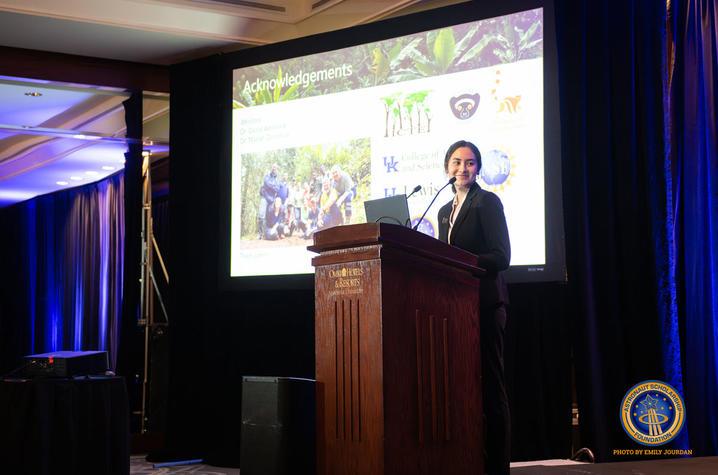
LEXINGTON, Ky. (March 4, 2026) — When she was a child, Jaesylin Stephens, a senior biology major in the University of Kentucky College of Arts and Sciences, saw nature documentaries on Madagascar. She never imagined that she would one day visit the east African county.
“I never dreamed I’d get to see it with my own eyes,” Stephens said. “I’ll never forget finding bamboo lemurs on my first day in the field. I couldn’t believe I was just a few feet below such a unique, rare and endangered animal in its natural habitat.”
That field experience in Madagascar, which was funded by Lewis Honors College’s Kate Johnson Scholarship, was central to the presentation she gave last year at the Astronaut Scholar Technical Conference in Houston.
“At the conference and symposium, I was honored to meet an extraordinary community of scientists, engineers and astronauts,” said Stephens, who also is a Lunsford scholar.. “I was thrilled to discuss cross-disciplinary research with fellow Astronaut Scholars who share my passion for scientific discovery.”
The Astronaut Scholarship is awarded to students in their junior and senior year of college studying science, technology, engineering or mathematics with the intent to pursue research or advance their field upon completion of their final degree. Applicants must have conducted a considerable amount of work outside the classroom, like research or internships, in their chosen field of study. An interest in aeronautics is not required.
Her experience last summer in Madagascar helped drive home what she had been learning at UK, bringing into sharper relief her purpose.
“It really drove home the ‘why’ behind my research,” Stephens said.
She also credited Mariah Donohue, Ph.D., and David Weisrock, Ph.D., from the Department of Biology, with inviting her into undergraduate research, making it possible for her to conduct research overseas. She added that the UK research faculty in her academic discipline emphasized skills like experimental design and science communication.
“This foundation prepared me to engage in real research with confidence,” Stephens said.
Stephens, a Louisville native, also is a student in the Lewis Honors College, She said she studies biology because of her fascination with the natural world.
“I’ve always been fascinated by how it works, from the molecular to organismal to the ecosystem level,” she said. “Majoring in biology at UK has allowed me the flexibility to explore how life functions at multiple scales while contributing to scientific research.”
When Stephens was in Madagascar conducting research last summer, she also attended the International Primatological Congress in the country’s capital, Antananarivo, an experience she said she was excited to share with mentors and fellow Astronaut Scholars.
“As an undergraduate, collaborating with an international team of academics and local naturalists was a truly incredible experience,” Stephens said. “Collecting data in one of the earth’s most biodiverse but fragile ecosystems underscored the importance of biological research for both science and conservation.”
Following graduation in May, Stephens said she plans to pursue a Ph.D. in biology and looks ahead to a career in research.
The Astronaut Scholarship is one of many award opportunities available for exploration through UK’s Office of Nationally Competitive Awards. That office assists current undergraduate and graduate students and recent alumni in applying for external fellowships scholarships funded by sources, such as a nongovernment foundation or government agency, outside the university. For more information on what awards are available and how to apply for them, contact director Schyler Simpson, Ph.D.